Values, Philosophy, and History Artifact

As a graduate of a theology master’s program, I consider the area of Values, Philosophy, and History to be one of my strong suits. Philosophical and moral/ethical reflection are important skills for such a program, and I excelled. Now in my new graduate program, College Student Development and Counseling, I was enculturated to the history, philosophies, values, and social context of the Student Affairs profession.

The final paper for my graduate course, Foundations of Academic Advising, required that I synthesize my learning in several disparate areas: educational philosophy, student development theory, student learning outcomes, ethical foundations, relational foundations, and academic advising roles and responsibilities. Synthesis is the second-to-highest type of learning in Bloom’s taxonomy. This synthesis is the most complex work I have attempted in this competency area, and it is also some of my best work. Therefore, I have chosen it as my artifact demonstrating my growth in Philosophy, Values, and History.


Technology Artifact

Working in EdTech, I have acquired various software-related skills. For several years, I spent each day teaching others how to use software, helping them extract and use data, and troubleshooting problems with their browsers, computers, or the software itself. In addition, I picked up database management skills, dabbling in SQL, which is a database management system, Information Architecture, and even some programming.

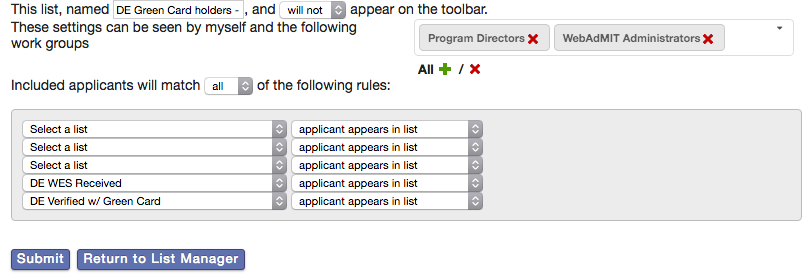
My first artifact is an example of a complex query known in the WebAdMIT software as a Composite List. It essentially creates a Venn Diagram of two separate queries. This is most useful when a query needs to be created that uses Any for some items and All for others, or when multiple data points create a certain condition, and that condition needs to be compared or overlapped with another condition. Below is an example of a Composite List that I created. The list queries all applicants to a particular nursing program that have a Green Card and have a WES evaluation received as part of their applications. The first screen shot is the Composite List itself. The next two screen shots show the individual simple Field Lists that are used in the Composite List. This query allows our admissions team to determine which International applicants are qualified to be admitted to that program.

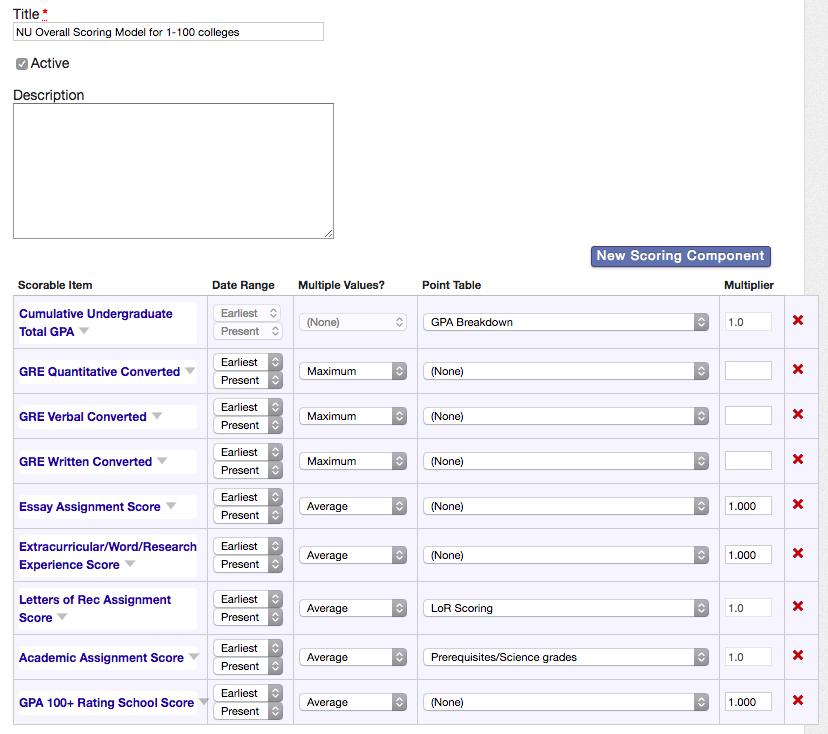
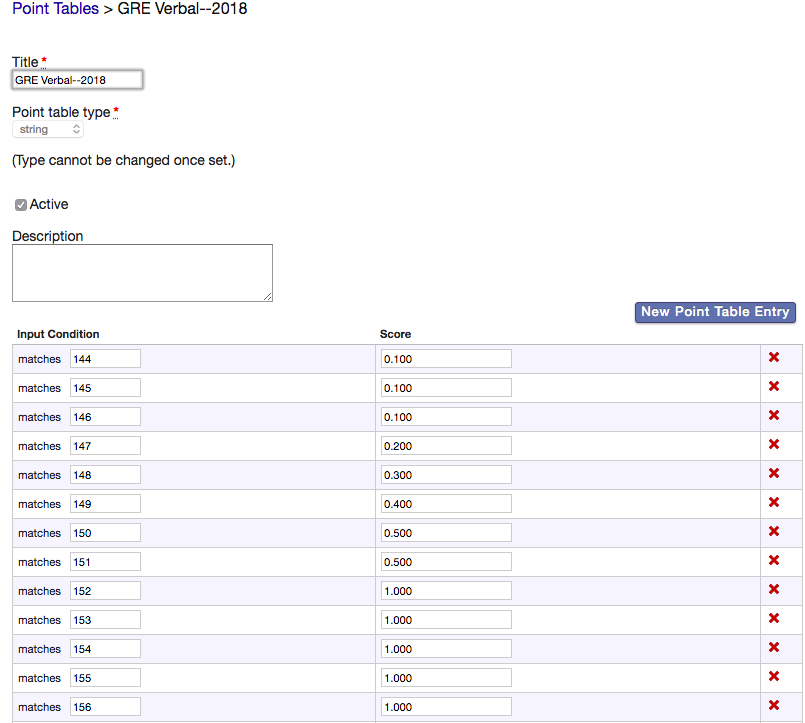
My second artifact showcases one of the most difficult technical skills I mastered: working with Scoring Models. Scoring Models are essentially algorithms. The user inputs each scoring component, or item needing to be quantified into the table. Then the user selects how each item will be quantified (e.g., sum, average, ect.) and the exact values that the model will be assigning to each component. Sometimes components have ranges of scores, such as GPAs and standardized test scores, in which values can be multiplied by the same number to get the assigned value. I assisted the Director of Northeastern’s Speech-Language Pathology master’s program to create the below Scoring Model, which is my second artifact. The first screen shot is the model itself, which was set up by the Director based on the components she needed. The second is two of the three point tables I set up for her to create the values for the GRE scores we receive for each applicant. The values generated for the GRE scores using the point tables factor into the Scoring Model as a whole. Based upon all the components we added, and their multipliers or point tables used, the model generates a single overall score based on a number of holistic dimensions. This overall score helps us determine which applicants would be the best fit for our SLP master’s program.

Student Learning and Development Artifact

One of the primary reasons I joined the College Student Development and Counseling (CSDC) program at Northeastern was to learn Student Development Theory and be able to operationalize that knowledge in advising sessions with students. In the first year of our program, we learned the theoretical and empirical foundations of College Student Development Theory. We then created our own theories focused on the needs of a student sub-population of our choice, followed by a program that might implement insights gained from our research. My partner and I wanted to focus on uncommitted students: that is, students who are in majors that their parents chose, or who are questioning or struggling with their major choices. These students are often hyper-aware of the real-world implications of their major choices for their careers, and are often fearful of failure and disappointing their loved ones. These things can lead to emotional turmoil or crisis.

Our Spectrum Program, created for a fictional public university, employs a cohort model with built-in mentorship for all four (or four-plus) years of a student’s academic program. This artifact combines all of the elements of our student development model and the various facets of start-up costs and logistics for our program. As I did not know anything about Student Development Theory at the beginning of the CSDC program, this project demonstrates my growth in the area of Student Learning and Development by showcasing the finished product of our year-long project.

Social Justice and Inclusion Artifact

Social justice has been a priority in my life since my first graduate school experience at Boston University from 2007-2010. Since then, I have participated in workshops on various social justice topics regularly. The first one was a weekend conference on immigration justice, which I attended in 2008. During my time at BU, I interrogated my own whiteness and white privilege, and continue to do so by engaging in online and in-person racial justice conversations. One example is the DONUTS workshop I attended that the Northeastern University Social Justice Resource Center provided in winter 2018. DONUTS stands for “Deconstructing Oppression N’ Unpacking whiTe Supremacy.” I have also participated in direct actions such as protests, pickets, boycotts, canvassing, and phone banking. Notably, I helped to lead a dance protest of the Hyatt Regency Boston during Pride Week 2010 to highlight its unjust treatment of its housekeepers to out-of-town guests. Four years later, Hyatt paid $1 million to those housekeepers (Johnston, 2014). Other successful campaigns in which I participated include the 2013 Cambridge Advocates for a Common Toilet campaign to provide public restrooms to homeless residents of Cambridge (Furigay, 2016), and the fall 2018 Yes on 3 campaign to protect civil rights of transgender persons in Massachusetts.

In my student affairs practice, I hope to work with students from disadvantaged backgrounds, but especially students of color, to help them succeed in college. The pull toward student success work is one and the same with my passion for social justice. I do not seek just “any job” that allows me to do social justice work on the side. I want a job where I can enact my values of true equality and respect for human dignity in my day-to-day work.

The artifact that best demonstrates my learning in the SJI competency area is a training I created during the year I was President of CAUSE Justice, the social justice student organization at BU School of Theology. During the winter of 2010, I created a training on Intimate Partner Violence for my peers to learn about how to pastorally respond to instances of IPV in their congregations. A friend of mine who had done her social work internship that year at the Boston Area Rape Crisis Center (BARCC) collaborated with me to create the handout packet (attached as a PDF). In our training, we explained why IPV is a social justice issue, and how religious leaders have traditionally responded by sending abused partners back to their abusers. We emphasized the pervasiveness of IPV, explained why pastors will likely encounter it multiple times in their careers, and proposed alternate responses. An important part of responsible helping is creating a safety plan. We included this in the handout and reviewed steps typically used in safety plans. We also encouraged participants to get to know leaders in their local shelters for IPV survivors (previously known as “battered women’s shelters”) to promptly open lines of communication. Finally, we discussed teaching healthy relationship skills to teenagers during religious activities such as youth group meetings. Our workshop was a success, as over 50 people attended and actively engaged with the content.

Throughout my life, I plan to continue learning about justice issues and expanding my horizons of compassion. I intend to keep working for justice both at work and in my personal life. I hope that in my student affairs practice, I can put this learning to work and benefit both students and staff in the process.

Personal and Ethical Foundations Artifact

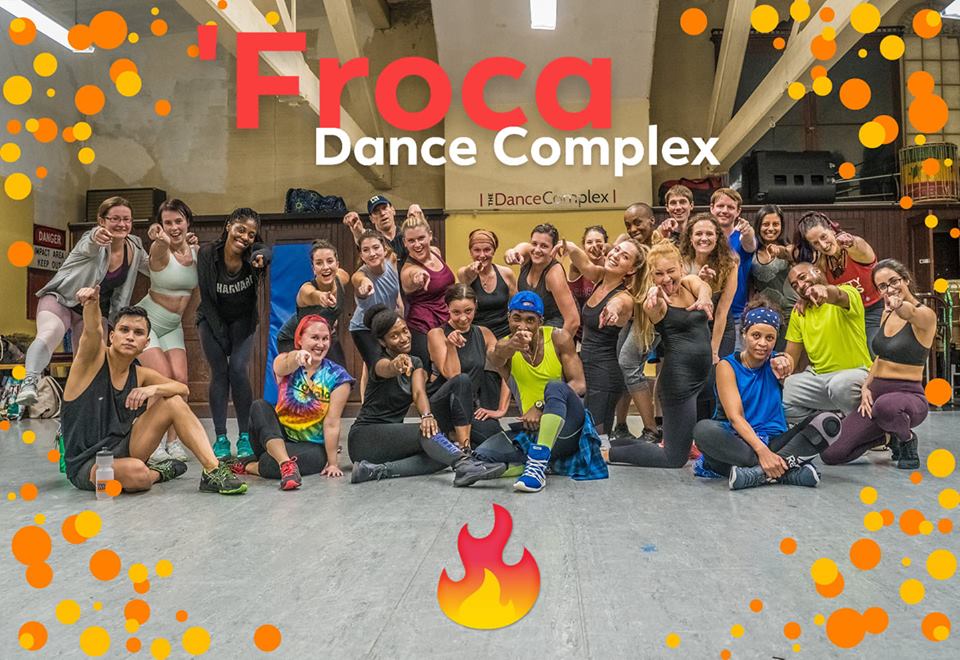
As I reflect on my growth in the competency area of Personal and Ethical Foundations, the artifact that best represents this growth is a demonstration of my progress in prioritizing my health. In college, it was easier to balance my wellness with my studies and campus involvement because I participated in extracurricular dance, and because I had dining hall staff who cooked my food each day. After college, I learned to provide my own food and exercise schedule. Today, I integrate 1-2 Zumba classes and one workout with weights into each week. I do my best to cook at home instead of eating out. In winter 2019, I learned new cooking techniques to create healthier at-home versions of restaurant favorites. These things require significant time investments and daily discipline.

This artifact is a picture of my Zumba class. I take ‘Froca Fitness at The Dance Complex in Cambridge. ‘Froca is a fusion of Afro-Caribbean dance and cardio aerobics. The social media trend of #SweatySelfies, which our class embraces, is an excellent weekly reminder of all the fun my friends and I have while we dance together.

Organizational and Human Resources Artifact

Organizational and Human Resources is the competency area that most challenges me. I have not yet encountered opportunities to manage others participate in a hiring process. I have, however, become adept at creating internal manuals and other resources, training materials, and presentations. This experience was useful when I was asked to create a manual for the admissions office where I work, the graduate admissions office at Northeastern’s Bouvé College of Health Sciences.

This training manual is the artifact that best demonstrates my learning in the OHR competency because it required that I comprehend and incorporate new information and processes quickly, and in return I had to create instructions that would aid in teaching others. It also required that I be able to communicate nuances in policy in ways that are both clear and professional. I finished the manual in Summer 2018 and have used it to train employees in subsequent semesters.


Leadership Artifact

As I mentioned in my competency reflection essay on Leadership, one of the most recent recent ways I have demonstrated leadership was in my job at the Bouvé College of Health Sciences graduate admissions office. In the last year, we have transitioned our nursing programs from our old admissions platform onto NursingCAS, the centralized application service for nursing programs. This application platform gives us access to a national pool of applicants, and boosts our visibility among applicants. This transition was not just a technological adjustment for our program directors: using the new platform required a paradigm shift for those evaluating applications to Northeastern’s nursing school. My response required working directly with the nursing program directors in Bouvé to gain their buy-in.

These artifacts are Local Status Guides that I created and sent to the nursing program directors to help them understand how applicants move through the application process in WebAdMIT, which is the admissions platform that receives NursingCAS applications. A Local Status tells us where the applicant is in the process, and where they need to go next. Changing a Local Status in WebAdMIT sometimes triggers emails to be sent or affects applications in other ways, so it’s important that instructions be clear and simple to understand. Although these guides are just a small part of my involvement in the many steps and meetings involved in transitioning programs to NursingCAS, they represent the final step in that process.

Law, Policy, and Governance Artifact

Prior to enrolling in the College Student Development and Counseling program, I lacked knowledge about law in higher education. I knew that federal and state law, as well as federal policy, affect the work of colleges and universities. Yet I did not know many laws beyond Title IX that apply to higher education. The Law & Ethics in Higher Education course I took in Fall 2018 helped me to become knowledgeable in this area at the Foundational level. I now understand the basics of risk management and major legal issues affecting higher education today.

In my final paper for this course, I was required to analyze legal problems in various scenarios and apply the knowledge I had gained in the course to find viable solutions for mitigating risk to the university. This artifact supports my mastery of this competency area because it was one of the most difficult assignments of this graduate program, but I produced strong work. I look forward to using this new knowledge to inform my practice.

Assessment, Evaluation, and Research Artifact

Last March at the 2018 NACADA Region 1 conference, I attended a workshop on assessment in academic advising. The workshop was extremely helpful in demonstrating how assessment and evaluation can help improve academic advising programs as a whole, as well as specific services and content provided to students by an advising office.

In my graduate course on Evaluation and Outcomes Assessment, I participated in a class project that evaluated a fictional career services department’s efforts to prepare undergraduates for internships. Although my group split up writing the paper and creating the presentation based on the stages of evaluation we each covered, we were responsible for understanding how all the pieces cohere. Our group’s problem involved assessing multiple constituencies within our our fictional university session. As a result, comprehensive assessment required contacting them and gathering feedback from each one in ways that were convenient for the participants.

This artifact is a copy of our group’s final presentation. It demonstrates the problem and an assessment approach used, which included asking the right questions, to collecting, compiling, analyzing, and presenting the data.


Advising and Supporting Artifact

My practicum experience at the University of Massachusetts – Boston (UMB) is in the advising center for the College of Science and Mathematics. All of my learning outcomes are centered on some aspect of academic advising. Advising students is my primary activity, and I have demonstrated Foundational mastery of this competency area in my work at UMB.

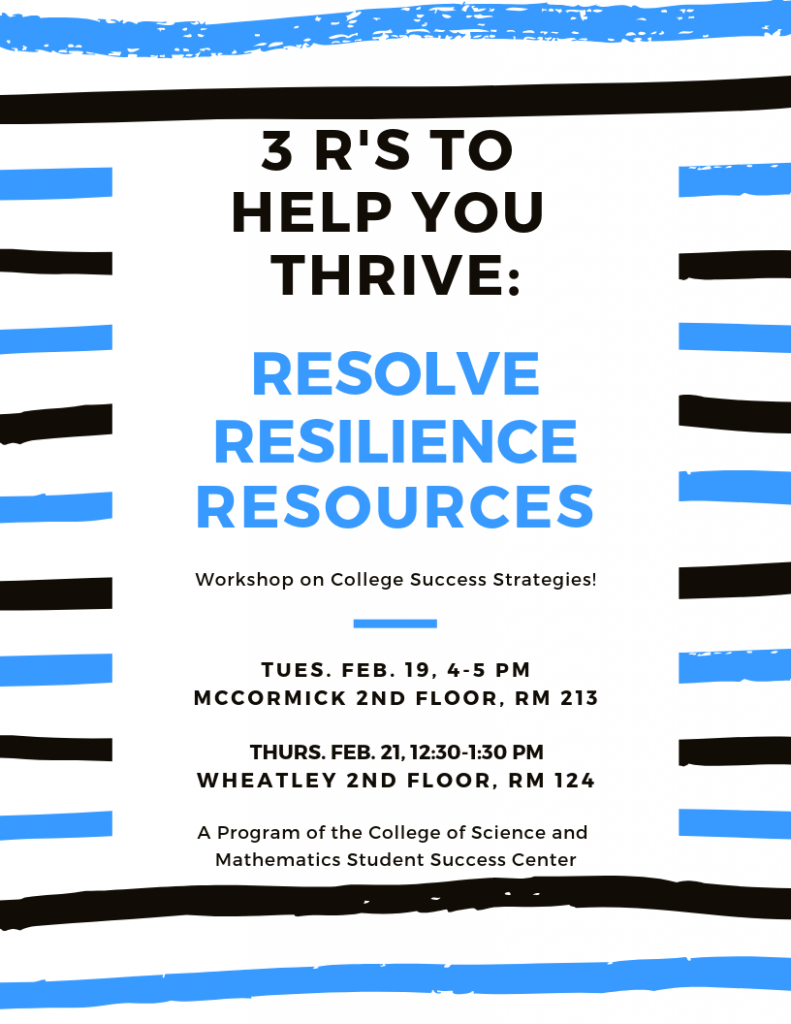
One of my learning outcomes for my practicum at UMB is to plan and execute a workshop that promotes student success. My artifact for the Advising & Supporting competency area is a workshop I have designed to meet UMB students where they are developmentally and to address gaps the in their needs. One of those needs is self-empowerment. Therefore, my workshop was designed to show students that they already possess the inner resources they need to meet their goals. By reframing the challenges present in their lives, they can often turn these challenges into strengths. The activities I selected help students engage in decision-making processes, reflect on their strengths, and set goals for the future. The workshop was presented one time for the college community and another for a group of Peer Advisors.

The artifact that represents my growth in this area is the flyer used to advertise my workshop. A detailed PowerPoint is available, however, the file is very large because I filled it with pictures and GIF files to fully engage students. The full presentation and presenter’s notes is located within the Contact Me tab of my website.